
St. Landry Parish Civil Docket Searches
Civil suits in St. Landry Parish go through the Clerk of Court's Courts Division. The Clerk's Courts Division overview lays out what that office holds, both civil and criminal. It draws one boundary worth remembering. The indexes reach back to the start of parish records. Suit images only run from 1997. An index result can still place an old matter in the records. It does so even when no image of each filing exists.
For a current district civil case, try the local ClerkConnect route first. The state clerks route is a backup for whatever category it covers. A case number beats a common name every time. When only a name search works, match party role, filing period, division, and case type first. Then ask staff to pull anything.
- Identify whether the case belongs to the 27th JDC, a city court, a justice court, an appellate court, or federal court.
- Collect the case number, party or business name, filing year, and the item needed.
- Use the Clerk's local access instructions and then the available statewide route.
- Check whether the result is a docket event, an index entry, a public document image, or only case metadata.
- Ask the Courts Division for inspection or a specific copy when the online result does not answer the request.
St. Landry Parish Civil Index and Images
Current local online access starts with the Clerk's ClerkConnect information page. Louisiana also offers a statewide clerks option, eClerksLA. Check its visible category and subscription terms before you count on it for a particular St. Landry Parish civil docket. A public information page says nothing about field-level detail once the live portal demands a login.
Older civil district suits show up in the Clerk's Archives & Research description. That description reaches from 1813 forward. This route matters when a case predates the available images. Figure out exactly what you need before you call. An index lookup, a docket, a pleading, a judgment, and a certified copy are separate products. Each carries its own access rules and fees.
| Record need | St. Landry Parish route | What to confirm |
|---|---|---|
| Recent docket or case information | ClerkConnect, eClerksLA, or Courts Division | Whether the result includes events, image access, or metadata only |
| Older civil district suit | Archives & Research | Index availability, image availability, and copy method |
| Limited civil or municipal matter | City court or justice court | That the matter is not held by the 27th JDC |
Civil Dockets: What They Show
A St. Landry Parish civil docket can list the petition, the citation or service return, an answer, an exception, a reconventional demand, an intervention, a motion, a rule, notices, scheduling orders, continuances, judgments, cost entries, appeal references, and redaction markers. An entry on the list proves an event happened. It does not promise the attachment is public or that a document image is online.
| Petition | The filing that begins a civil suit or states the requested relief. |
|---|---|
| Service or return | An entry showing that citation or other service activity was issued or returned. |
| Answer or exception | A response or procedural objection filed in the case. |
| Setting | A scheduled motion, rule, conference, trial, or other court event. |
| Judgment or disposition | The court's formal order or the status shown for a resolved event. |
Treat the docket as a timeline. A scheduled hearing is not always the final trial. Even a case marked disposed can pick up an appeal, a collection entry, or other later activity. And a public docket still leaves some exhibits and attachments off limits.
St. Landry Parish Civil Pleading Path
Most civil dockets open with a petition. Citation and service come next. Then an answer or exception, motions and rules, a setting, and finally a judgment or dismissal. The path can branch along the way. A reconventional demand is a counterclaim filed by the responding party. An intervention lets another person or entity join the case. Both add events and service questions to the St. Landry Parish civil docket.
Expect to see discovery notices, subpoenas, mediation references, settlement activity, writs, and execution entries too. When you request a record, use the docket term that matches the item. Ask for the service return, the judgment, or a conformed copy. That beats asking staff to interpret an entire civil file.
A docket entry can confirm a document exists. The document itself may stay redacted, sealed, confidential, or available only through the Clerk.
What Cases Fill the Civil Docket
Civil docket activity in St. Landry Parish spans contract, tort, property, domestic, probate or succession, adoption, garnishment, seizure, and other suits. All fall within the court's authority. The category shapes where you look and what you can see. Adoption and certain family or juvenile records carry restrictions. A routine public civil filing does not.
Some limited civil, eviction, or municipal cases sit with a city court or justice court instead. They do not go to the 27th JDC. Searching land records is no substitute for the civil docket. Even so, a property dispute can produce separate recorded instruments. And when a state civil case gets removed to federal court, the federal docket lives in PACER. It will not appear in a St. Landry Parish ClerkConnect result.
St. Landry Parish Civil Cost Snapshot
Filing fees in St. Landry Parish civil cases shift with the type of suit. The Clerk's current court-cost page warns that any figure stays an estimate. That holds until a final judgment or dismissal arrives. The 2024 numbers here are a snapshot, not a quote. Before you file, confirm the amount. Check the Clerk's 2026 court-cost PDF and the Courts Division itself.
| 2024 listed item | Dated amount |
|---|---|
| New civil suit | $400 |
| Adoption | $500 |
| Appeal motion, answer, or reconventional demand | $300 |
| Garnishment | $500 plus service |
| Plain copy, certified copy, conformed copy | $1 per page, $5, and $3 |
| Citation and sheriff service | $20 and $100 |
| Transcript and certification | $2 per page plus $5 |
The official cost page is the source for the Clerk's current estimate warning.
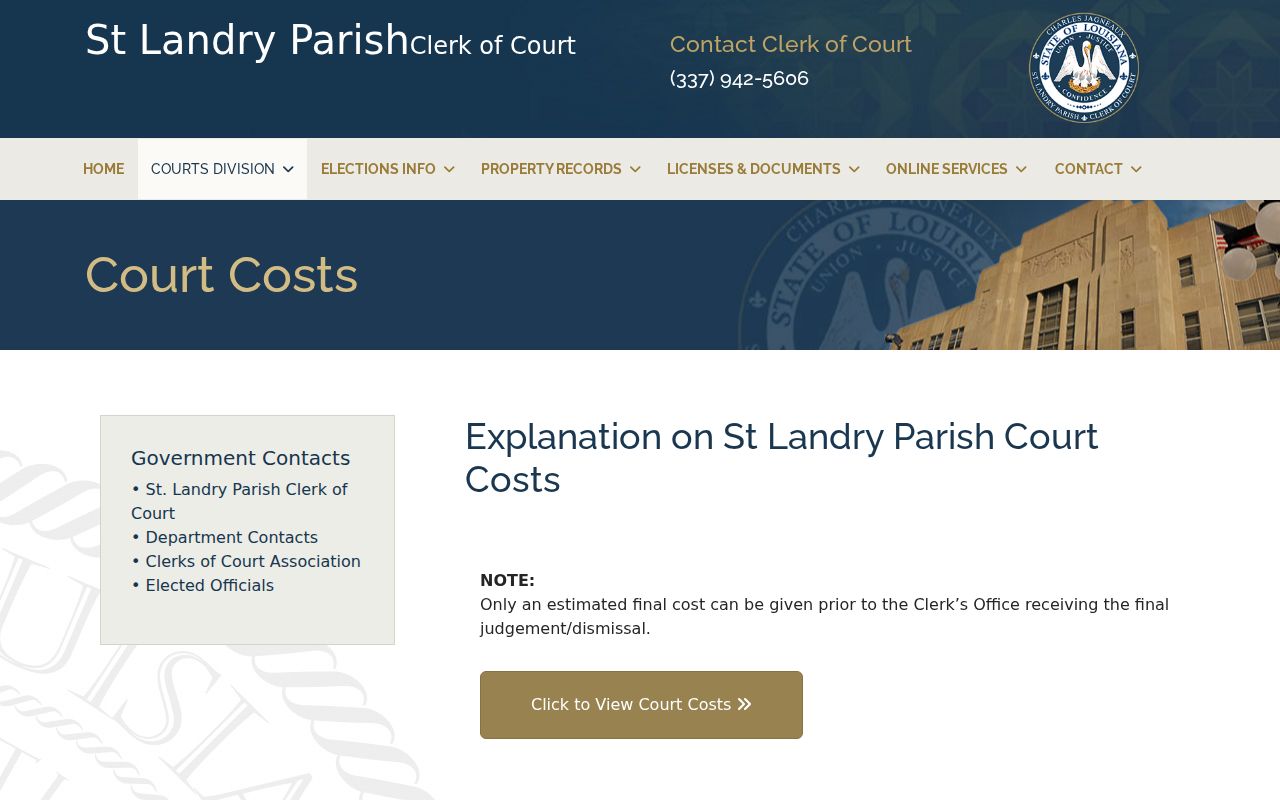
That warning is exactly why a dated fee table should frame your questions rather than predict a final filing total.
Hearings on the Civil Docket
A civil setting covers many things. It might be a filing, service event, motion, rule, conference, hearing, trial, judgment, or post-judgment event. In the 27th JDC, contested divorce matters sit on the regular civil docket, while uncontested motion or rule matters go to a morning hour or designated motion docket. So the setting type matters as much as the date itself. Ordinary civil cases are randomly allotted among the four district divisions, which means a good calendar check includes the case type, division, and exact setting. A continuance on a docket only means the prior setting was postponed or moved. Confirm the replacement date through the Clerk or the assigned court. Never assume a new date from an old calendar entry.
St. Landry Parish Civil Court Boundaries
The 27th JDC is not the only place civil records live in St. Landry Parish. Opelousas and Eunice city courts, mayor's courts, and the individual justice courts each keep their own limited-civil dockets and local records. A justice court can hold concurrent civil jurisdiction up to the amount stated in Louisiana law. Municipal and city court matters move through their own channels. Federal matters take a different path. A removed state case, federal-question case, diversity case, or bankruptcy belongs in PACER and the proper Western District court, not with the state Clerk. A Third Circuit appeal is its own appellate case with a new case number. Get the court right at the start. That prevents the false conclusion that a record is unavailable.
Who Can See Civil Dockets
Who holds the civil docket? The Clerk of Court does, by law. La. C.C.P. art. 251 lets anyone examine and copy public records during office hours. The law sets its own limits. A visitor can ask to view a public civil docket or take notes from it. Copies come in several forms. Certified, plain, conformed, transcript, and electronic versions are all possible. Each carries its own fee and availability.
Filing online does not weaken privacy rules. La. C.C.P. art. 14.1 puts the redaction duty on the filer. Public access to anything accepted still depends on the law. A St. Landry Parish civil docket entry may therefore link to a redacted PDF. It might offer a restricted attachment instead. Or it may show no public image at all.
Want the exact rule text? Louisiana's electronic filing law spells out the redaction duty. It also explains how public access works for accepted filings.
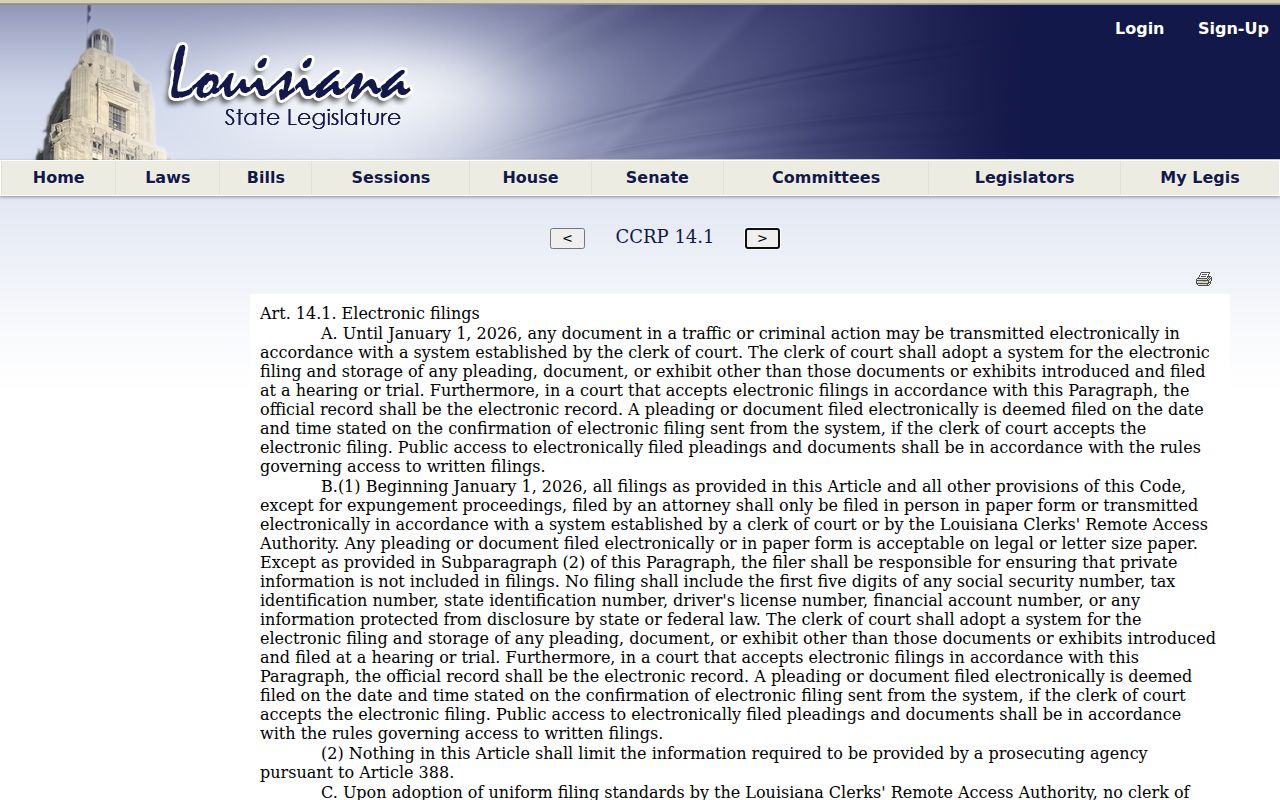
Even an accepted filing stays limited by rule, court order, and protected-information requirements before the public can see it.
St. Landry Parish Civil Access Requests
St. Landry Parish civil access runs along several routes. ClerkConnect and eClerksLA carry available online information. The Courts Division handles current cases. Archives & Research holds historical civil material, while the Clerk's current phone, mail, email, or fax channel accepts a narrow request. Ask about a public terminal before planning an in-person lookup.
A written public request can cite art. 251. It should name the court, the case number or a narrow date range, the case category, and the exact item. State an inspection or copy preference and any certification need. If an item is withheld, ask for the legal basis. City and justice-court cases belong with their own courts. PACER serves the federal branch. Keeping each request with the office that actually maintains the civil record saves everyone time.
Before visiting in person, confirm the department and record series. Courts Division keeps current court records; Archives & Research keeps its listed historical civil series. A docket request and a request for a recorded land instrument should stay separate. The Clerk treats those as different records services.