
St. Landry Parish Criminal Docket Searches
For a district criminal matter in this parish, the main stop is the Twenty-Seventh Judicial District Court for the Parish of St. Landry. It is often shortened to the 27th JDC. Records flow through the Clerk of Court's Courts Division. That office offers a ClerkConnect and eClerksLA access route. Results vary by case category and by the account or subscription you hold during the search. So write down the case number, filing year, and division any result displays. Sort first by court. A parish district case sits apart from a city, mayor's, justice-court, appellate, or federal case. A name match may point to a party, an attorney, a witness, or some other role entirely. The Clerk's research approach favors a case number where one exists, followed by a tight request for a docket, minute entry, judgment, sentence, or disposition. Vague requests for a whole file slow things down.
- Identify the court and whether the matter is district criminal, municipal, appellate, or federal.
- Gather the case number, filing year, and charge category if they are available.
- Check the local ClerkConnect route and then eClerksLA for the category each service exposes.
- Compare the case metadata, division, and event dates before treating a result as the right case.
- Ask the Courts Division for a narrow public entry or copy if an online result is absent or incomplete.
- Use the separate custodian when the case belongs to a city court, justice court, Third Circuit appeal, or federal court.
Note: A failed online lookup can mean many things. The category may be restricted, the indexing historical, the spelling off, the system down, or the case simply held by another court.
St. Landry Parish Criminal Search Routes
No single free statewide name search reaches every St. Landry Parish civil and criminal docket. So work the routes in order. Start with local ClerkConnect access. Then try the Louisiana clerks route for whatever categories it exposes, and fall back to the Courts Division. The Courts Division overview confirms that criminal records sit with the Clerk's court-record holdings, not with a payment vendor or any investigative agency.
| Route | Best use | Important limit |
|---|---|---|
| ClerkConnect | Local St. Landry Parish access when current enrollment permits it | Live field and coverage details should be confirmed with the Clerk |
| eClerksLA/LCRAA | Statewide clerks access for supported record categories | It is not a complete image archive for every criminal file |
| Courts Division | Inspection, copies, minutes, judgments, and custodian questions | Public access remains subject to confidentiality rules |
The District Attorney contact page lists the felony, traffic, and administrative routing channels. That office answers prosecution questions. It is not the neutral keeper of the full St. Landry Parish criminal docket, though, so treat it as one stop rather than the record's home.
Those contact channels help distinguish prosecution routing from the Clerk's court-record role.
Criminal Dockets: What They Show
Think of a St. Landry Parish criminal docket as a timeline of actions in a case. One line might be a charging event, a bill of information or indictment, counsel appearing, a motion, a setting, or a minute entry. Later lines can carry a plea, verdict, or sentence. Cost entries, appeals, writs, and expungement-related events appear too. A docket line is not the document itself. Remember that it is not a transcript, exhibit, or police report either.
| Case number | The court's identifier. The research did not establish one complete public St. Landry format, so verify the applicable year and court with the Clerk. |
|---|---|
| Division and judge | The assigned 27th JDC division or other court unit, which helps distinguish same-name results. |
| Setting | A scheduled arraignment, motion, pretrial, trial, sentencing, rule, or other event. It is not automatically a trial date. |
| Minute entry | A court or clerk summary of an event or ruling that can be shorter than a full transcript. |
| Disposition | The recorded outcome or current resolution. Read the exact entry rather than assuming what a status means. |
Read each charge and event with care. An arrest is not a conviction. A charge is not proof of guilt either. When a charge is dismissed, amended, or nolle-prossed, describe it by the docket disposition, and note that a sentence entry may not reflect later completion, appeal activity, or expungement.
St. Landry Parish Criminal Minute Access
Need just one minute entry from a St. Landry Parish criminal docket rather than the whole file? Louisiana law now helps. La. R.S. 13:5992 requires public electronic access, through the Louisiana Clerks' Remote Access Authority, to criminal minute entries or summaries for matters filed on or after January 1, 2020, subject to lawful restrictions. So the LCRAA route works well for newer criminal activity in St. Landry Parish.
The rule has limits. It does not force clerks to post every filing image, discovery item, exhibit, transcript, police report, or sealed record. Before requesting anything, figure out what the item actually is: a minute entry, a docket line, a judgment, or a certified copy. Older material takes different paths. The Clerk's index and image history, the Courts Division, and the Archives route can each matter.
The criminal minute-entry law itself sets this electronic-access minimum. The official page spells out exactly what it covers.
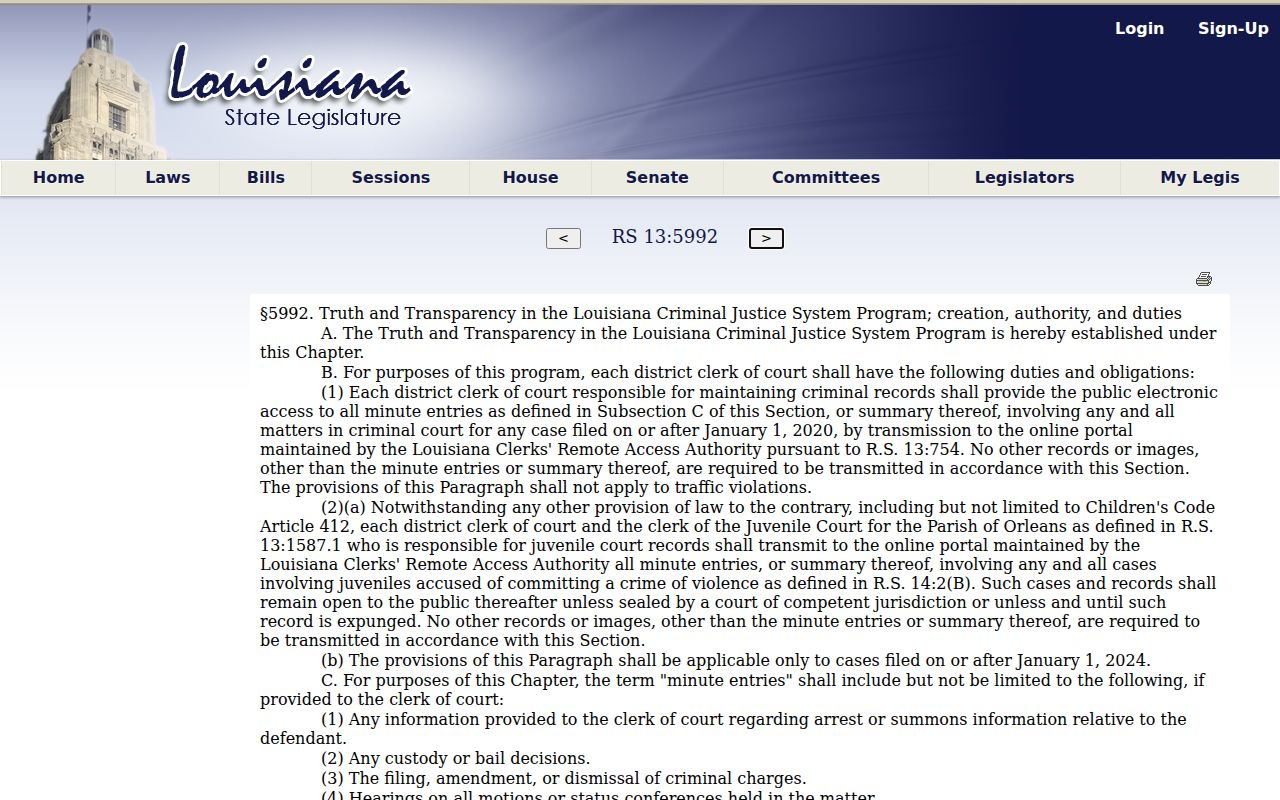
Minute entries summarize each act on a St. Landry Parish criminal docket. That is why a summary can exist when the full record image cannot.
Criminal Case Stages on the Docket
A St. Landry Parish criminal docket often reads like a story in stages: filing, arraignment, pretrial activity, plea or trial, disposition, and sentencing. Treat the order as a reading aid, though. It is not a promise that every case hits every step. Some events happen more than once. Between the main stages, the court record can fill with motions, discovery notices, status settings, continuances, and post-conviction entries.
Docket flow: Filing › Arraignment › Pretrial › Plea or Trial › Disposition › Sentencing
A few labels carry most of the weight on a criminal docket. Arraignment is the proceeding where charges and a plea or status are addressed. A continuance just postpones a setting. A minute entry summarizes a court event. Read each label together with its date and next setting. Do not trust a single status word alone. That pairing gives a far more reliable view of where the case stands.
Note: a later appeal, writ, probation-related entry, or expungement matter can show up after a disposition without changing what the earlier entry recorded.
St. Landry Parish Criminal Allotment
Criminal cases in the 27th JDC land in one of four divisions by random allotment. This happens under the court's local rules. Not everything runs through that system. Traffic, juvenile matters, non-support, protective orders, and preliminary hearings each get their own track. So a St. Landry Parish criminal docket search should always confirm the case type and the division handling it. That check matters when party names are similar. It also matters when two cases involve the same people.
Allotment follows a local appendix for new felony arrests. Each one goes to a fresh division. But if a related felony is already pending elsewhere, a motion can consolidate the two. So a division line on the docket tells you something real. A later arrest does not have to sit in the same division as an earlier case. The DA's department description shows that criminal and traffic functions stay separate. For the full case history, rely on the court's assignment and the Clerk's docket.

Keep that split in mind. Match any St. Landry Parish criminal record request to the court and the category that actually hold the matter.
St. Landry Parish Criminal Docket Courts
Felony and criminal docket records in St. Landry Parish run mainly through the 27th JDC and its Clerk's Courts Division. The Clerk lists criminal records among its court holdings. But not every matter sits there. A parish traffic case, a municipal ordinance matter, a city-court filing, and a justice-court case can each follow its own procedure. So an empty district search does not mean the record is missing.
The lower courts are the other channels. Opelousas City Court and Eunice City Court handle city matters. Mayor's courts such as Sunset and Port Barre handle local violations. Individual justice-of-the-peace offices handle their own. A St. Landry Parish case that reaches the Third Circuit on appeal gets a separate appellate docket. Federal prosecutions belong to the Western District of Louisiana. Search those through PACER rather than the parish Clerk.
Unsure which court holds the file? Start with the paperwork. The charge category, the issuing agency, the citation or case number, and the court named on the documents will point to the right place. That small step keeps the request from landing at an office with no responsibility for the record.
St. Landry Parish Criminal Record Split
A criminal docket is a court record, not an investigative file. Within the public-access rules, the Clerk can provide the district docket, minutes, judgments, and copies. The District Attorney handles prosecution routing. Arrest reports, evidence, and other agency records sit elsewhere. They rest with the sheriff, a municipal police department, or a Louisiana State Police unit. Each of those is a separate request with a separate keeper.
Let the court docket tell you what was filed, set, heard, or disposed in court. Go to the agency that wrote an arrest or incident report for that document. One caution: a traffic-payment confirmation says nothing about the outcome. Whether a charge was convicted, dismissed, amended, or sent elsewhere shows up only in the disposition. You request that from the proper court channel.
Federal cases work differently. PACER is the public-access system for a federal indictment or federal criminal docket. A state ClerkConnect search never reaches it. A federal search does not substitute for the St. Landry Parish court record either.
Access Rules for Criminal Dockets
La. C.C.P. art. 251 names the clerk as legal custodian and backs public inspection and copying during open office hours, subject to law. Your request can ask for inspection, a plain copy, a certified copy, a minute entry, a judgment, or another identified item. Ask first what product is available and what it costs. That beats asking vaguely for a whole file.
Public-access limits: La. R.S. 13:5992 provides the newer criminal minute-entry route, not a guarantee of every image. La. C.C.P. art. 251 governs the Clerk's custodian and inspection role. Juvenile matters, sealed material, redacted filings, and expunged records can remain restricted under separate law or court order.
Sometimes a docket search returns little or nothing. Juvenile, sealed, expunged, and otherwise protected cases stay out of public view. Never ask staff to work around a restriction. Instead, ask for the legal basis for withholding, and confirm whether another court, a different category, or an authorized process applies.
St. Landry Parish Criminal Request Detail
A tight St. Landry Parish criminal request names the court. Include the case number or a narrow year range, the charge category, and the exact product. Say which one you want: inspection, a plain copy, a certified copy, a minute entry, a judgment, a sentence record, or a disposition. Then ask the Courts Division which mail, email, fax, phone, or in-person channel it currently accepts for that request.
No online result? Call the Courts Division before assuming the record does not exist. The matter may be restricted, historical, filed in a city or municipal court, or indexed under a name variation. Visitors researching in person can ask about a public terminal or index. For mail and electronic requests, keep them narrow. Confirm the current cost and delivery method before sending payment.
Remember that public access does not permit unrestricted reuse of personal information. The clerk or court that keeps the underlying record is the most reliable end point.