
How the St. Landry Parish Court Calendar Works
The 27th Judicial District Court for the Parish of St. Landry runs four divisions. The Clerk posts no single public calendar URL holding every hearing. A St. Landry Parish court schedule search works best when you start with the court type and the setting type. Then bring a case number or party name. ClerkConnect, the local route, can supply current case information when it is enabled. The Courts Division or the assigned division can confirm any setting. Traffic, non-support, protective-order, juvenile, and hearing-officer matters are allotted differently from ordinary civil and criminal cases. A judge's name alone may not land you on the right St. Landry Parish court calendar entry. One case can carry dates for filing, service, arraignment, motions, rules, status conferences, pretrial, trial, sentencing, judgment, and post-judgment steps. The label on the entry tells you what the date means. Treat any past docket printout as history, not as proof of a current appearance. A court schedule is a time-sensitive record.
St. Landry Parish Court Division Checks
The Clerk's 27th JDC judge page shows each division with its direct chambers number. Judges and assignments shift over time. Recheck the live roster before leaning on a name or number for a current St. Landry Parish court schedule question.
Division A
Gregory Doucet
337-948-0588
Division B
Laura Garcille
337-948-0586
Division C
Charles Cravins
337-948-0584
Division D
Jason Meche
337-948-0580
The official judge directory is the source for that research-date roster.
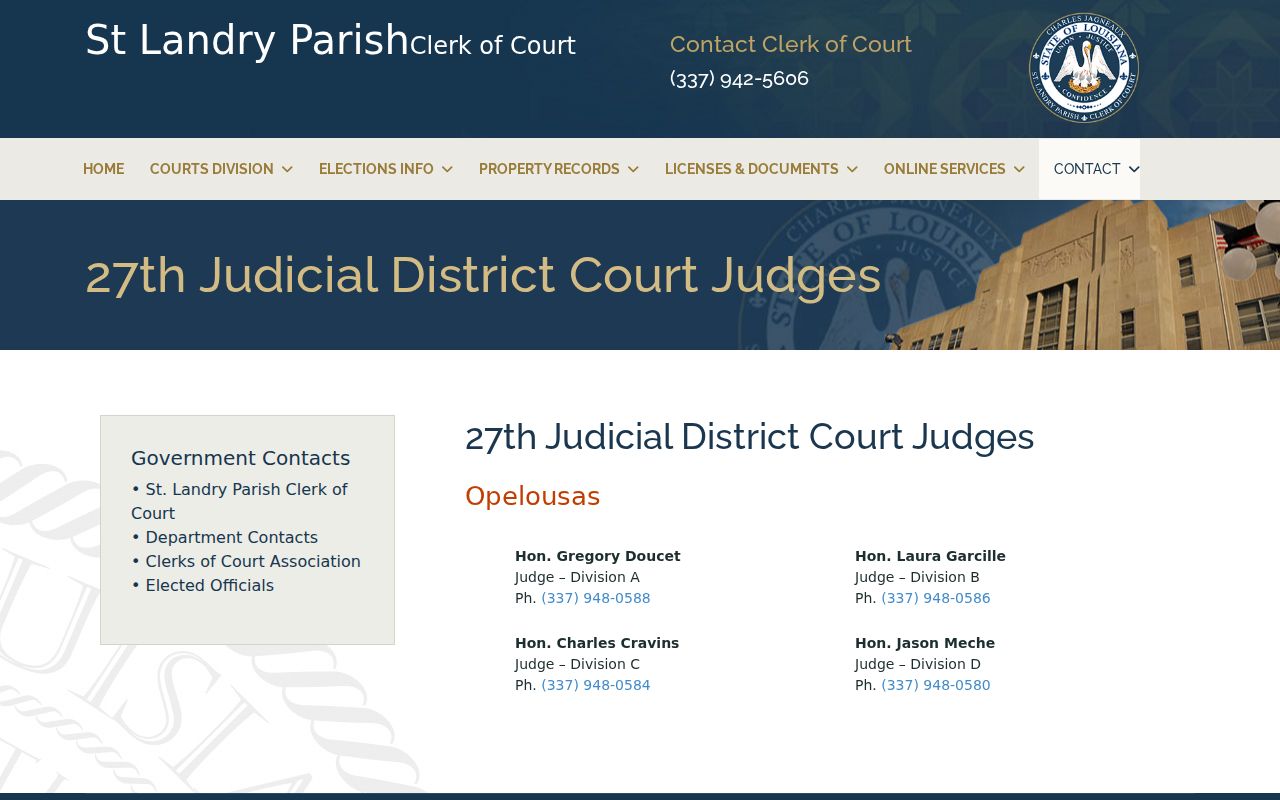
Division details help you verify which court owns a setting. They do not replace a live calendar confirmation with the clerk.
St. Landry Parish Court Date Lookups
Start with your own papers. The summons, citation, minute entry, last order, or notice may state the time, court, division, appearance method, and event type in one place. Then match the source to that court. A St. Landry Parish court date may sit in an authenticated local docket view, with the Clerk, with a courtroom clerk, with a municipal office, or in a separate appellate or federal system.
- Read the case paperwork for the case number, date, time, court, and setting type.
- Check ClerkConnect if the current local docket or calendar view is available for that category.
- Call the Courts Division or the assigned division chambers to confirm a 27th JDC setting.
- Visit the Courts Division, courtroom clerk, town hall, city court, or justice-court office for the court that holds the matter.
- Use the municipal calendar source for a local court, or the Third Circuit, PACER, or bankruptcy calendar route for an appellate or federal matter.
- Use the Louisiana Supreme Court's closure-order information when an emergency order may affect a setting.
- For a past calendar or minute entry, send a narrow mail, email, or fax request to the relevant clerk; do not rely on a slow channel for a same-day appearance question.
The Clerk's local access information and the Courts Division overview are the two local starting points. Ask whether a public terminal is open before you make a special trip.
St. Landry Parish Court Calendar Channels
No single channel covers every St. Landry Parish court matter. Opelousas City Court and Eunice City Court keep their own city-court contacts. Port Barre publishes a monthly magistrate-court schedule, and Sunset posts a Mayor's Court schedule for the second Monday of each month. Do not assume those municipal dates show up on a 27th JDC docket. Parish traffic court meets once a month per the traffic payment information. But the citation controls your exact appearance date. The nCourt payment path is a payment tool. It is not a full public calendar or docket history. For a state police citation, take fine and disposition questions to local parish traffic court and sheriff channels rather than Troop I.
| Matter | Calendar custodian to check | Do not assume |
|---|---|---|
| 27th JDC civil or criminal | Courts Division or assigned division | One universal public calendar URL exists |
| City or mayor's court | The named city or town court office | It appears in the district docket |
| Federal or bankruptcy | PACER or the federal court calendar | The parish Clerk searches federal cases |
Court Settings: What Each Field Means
A setting is a scheduled court event. Read the complete line, not just the date. A St. Landry Parish court schedule entry may show an individual appointment time or a docket-call time, and either can shift through a continuance or an order. If a field is blank in an online result, ask the clerk instead of filling the gap by guesswork.
| Date | The scheduled calendar day. It may be a hearing, conference, filing event, or another setting. |
|---|---|
| Time | The listed time. It may be a docket call rather than the moment an individual matter is heard. |
| Court or division | The court unit, assigned judge, hearing officer, or separate municipal or federal forum. |
| Location or platform | A courtroom or remote instruction if the current order or calendar displays one. |
| Setting type | Arraignment, motion, rule, conference, trial, sentencing, judgment, or another named event. |
| Status note | A continuance, disposition, cancellation, or other note that must be read with the date. |
St. Landry Parish Court Setting Terms
Short labels carry big differences. A St. Landry Parish court docket may use a date for an arraignment, where charges and a plea or status get addressed, or for a motion hearing, where one specific request is argued. A rule is its own kind of setting. Read it from the actual notice or entry. Call a trial a trial only when the docket says so.
- Setting
- A scheduled hearing, conference, trial, rule, or other court event.
- Continuance
- A postponement or rescheduling of an existing setting.
- Minute entry
- A court or clerk summary of an event or ruling.
- Arraignment
- A criminal proceeding that addresses charges and records plea or status.
- Disposition
- The recorded outcome or current resolution of a case or charge.
Family and support dates bring more terms. Under the hearing-officer rule come custody, visitation, support, intake conferences, rules to show cause, protective orders, and juvenile traffic matters. In covered cases the local rule sets intake within 30 days after the initial pleading, with a rule-to-show-cause setting normally no sooner than 10 days after intake. Exact assignment and appearance method still depend on the case.
When a Court Date Moves
Court dates in St. Landry Parish shift for many reasons. A continuance, a court order, weather, or a building problem can all push a setting to another day. The docket may show the change as a new setting, a continuance note, a minute entry, or an order. Always confirm through the court's current channel. An old calendar line that still sits in a historical docket view proves nothing about where the case stands now.
Calendar patterns differ across case types, too. Contested divorce matters land on the regular civil docket. Uncontested motions and rules may go to a morning hour or a designated motion docket. So a divorce date might be a contested setting, an uncontested motion date, a rule, or simply a filing and status event. It tells you very little about how long the divorce itself will take.
Before you travel, ask about public attendance, remote appearance, identification, security, and any local rule. If the precise history matters, pair a copied docket with a request for the calendar or minute entry and the resulting order.
St. Landry Parish Court Calendar Exceptions
Not every St. Landry Parish matter sits on an ordinary district civil or criminal calendar. Traffic, non-support, protective-order, juvenile, and hearing-officer cases each follow their own track. So check the court and the record category together. Paying a traffic ticket online is not the same as a court date. Juvenile and protected matters can carry access limits. That leaves a general public calendar search incomplete.
A district case that reaches the Louisiana Third Circuit moves onto a separate appellate docket and calendar. The Louisiana Third Circuit Court of Appeal supplies that separate appellate context. The court's public site is the place to read the appellate court information.
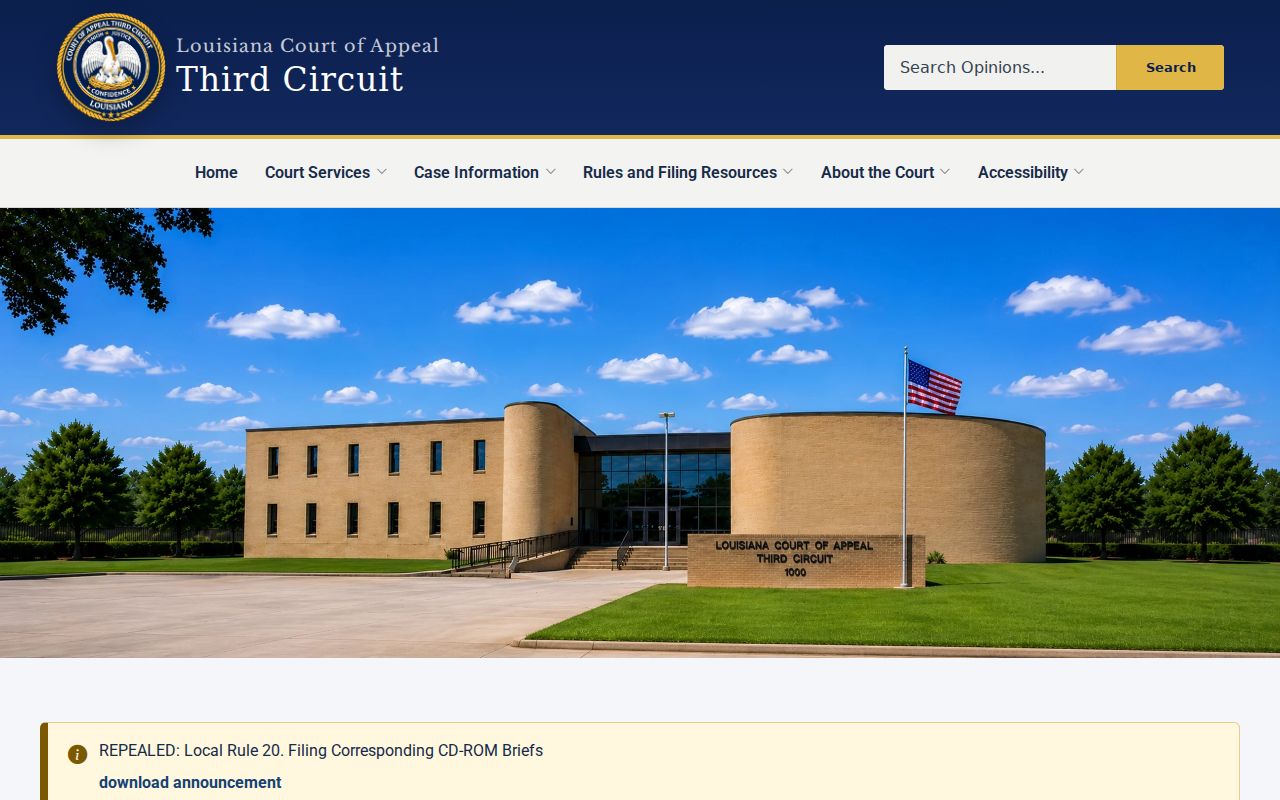
An appeal opens a fresh court calendar track. Nothing about the district case number lets you assume the appellate schedule, so check the Third Circuit's own docket.
Missed Settings and What Comes Next
Miss a St. Landry Parish court setting? Confirm the situation promptly with the court that owns the case. There is no single uniform outcome across civil, criminal, traffic, municipal, family, or federal settings, because the consequence and the next procedure depend on the case type, the court order, and the current record. Give the case number when you ask what occurred and whether a new date, order, or filing is now required.
Confirm promptly: Contact the clerk, assigned division, traffic clerk, municipal court, or attorney of record as appropriate, and ask for the current status, any resulting order, and the correct next setting.
Do not assume that a payment confirmation, old docket entry, or a notice from another court establishes the current appearance requirement.
For a past event, request the minute entry, calendar entry, or resulting order by date and case category. A narrow request gives the clerk a clear record to work from.
St. Landry Parish Court Closure Checks
Check operating status as close to the setting as you can. St. Landry Parish courthouse operations have been hit by closures before. One documented example is a 2024 water-leak closure. Louisiana Supreme Court orders also document storm-related closures later in 2024, plus 27th JDC closures in 2025. Those are dated examples of continuity planning. They are not current closure notices or predictions.
To confirm an active disruption, use the court's current notice. The Clerk, the assigned division, your summons, or the Louisiana Supreme Court's current closure-order collection can also confirm it. When a building is temporarily unavailable, online access, a phone call, and a written request can all still help. One caution applies. Mailing, faxing, or emailing an appearance question is never proof the court received it in time.